

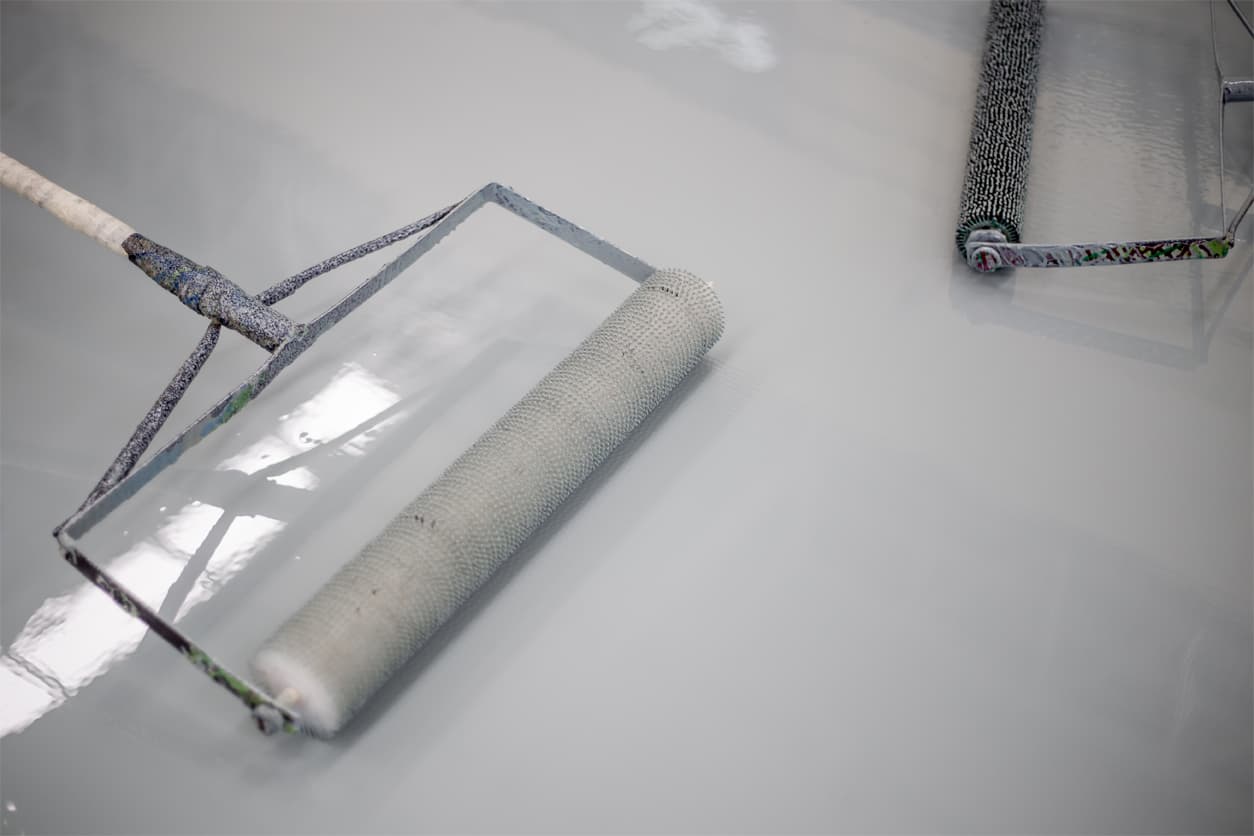

How to Apply an Epoxy or Urethane Sealer
Epoxy and urethane sealers are typically polymer solutions that are rolled onto the surface of a concrete slab, giving it excellent abrasion and spill resistance while enhancing the concretes visual appeal. Epoxies and urethanes are much stronger than acrylic sealers, making it a much better choice if you need a surface sealer in a high traffic area. They are frequently used in large retail stores, industrial areas, and warehouse floors; they are even used in most airports.
Application Instructions for the Epoxy 325 are as follows:
Surface Preparation: The concrete substrate to be coated must be clean, dry, and completely free of loose particles, grease, oil, or any substance that would interfere with proper bond. Surface and air temperatures must be at least 55°F during application. Surface and air temperatures should not exceed 90°F. Keep material from freezing. The surface-zone moisture content of the concrete should not exceed 4% wt. A test should be made to determine that the concrete has an appropriate vapor barrier. This can be done by placing a 4’X4’ plastic sheet on the substrate and taping down the edges. If after 24 hours, the substrate is still dry below the plastic sheet, then the substrate does not show signs of eventual hydrostatic pressure problems that may later cause disbanding. For a one or two coat thin build system (3-10 mils dry) we recommend either mechanical scarification or acid etching until a suitable profile is achieved. For a complete system build higher than 10 mils dry, we recommend a fine brush blast (shot blast). If acid is used to clean the concrete, neutralize the surface completely and rinse it with water prior to application. Then wait for the concrete to dry out for at least 24-48 hours.
Mixing: This product comes pre-packaged by weight. Kits should be mixed in their entirety. Epoxy 325 A and Epoxy 325 B should be thoroughly mixed before combining. Scrape the bottom and sides of each container. Epoxy 325 A and Epoxy 325 B can then be combined (Epoxy 325 is sold as a pre-packaged kit and Epoxy 325 Part A should be mixed in its entirety with Epoxy 325 Part B). After the two parts are combined, mix well with slow speed mixing equipment such as a jiffy mixer until the material is thoroughly mixed and streak free. This product is an emulsion product and should be mixed well before using.
Application: Test the sealer in an inconspicuous area to ensure the desired coverage and appearance is achieved. The mixed material can be applied by brush or roller. Workable time is about 1 hour. Maintain temperatures within the recommended ranges during the application and curing process. Apply material with relative humidity within the parameters. When the end of the pot life has been reached, you will find that the material becomes hard to apply and will actually tend to roll back up onto the roller. Do not try to continue application when the coating has reached this step. Applications made at different times with differing environmental conditions, may show slight variations in gloss. Coverage is approximately 200 sq. ft. per gallon. Make sure you test the surface for dryness prior to use and allow at least 8 hours before walking. A full cure will take up to 7 days to complete.
Recoating/Topcoating: If you opt to recoat or topcoat this product, you must first be sure that all of the solvents and water have evaporated from the coating during the curing process. However, it is best to test the coating before recoating or topcoating. This can be done by pressing on the coating with your thumb to verify that no fingerprint impression is left. If no impression is created, then the recoat or topcoat can be started. Always remember that colder temperatures will require more cure time for the product before recoating or topcoating can commence. Before recoating or topcoating, check the coating to insure no epoxy blushes were developed (a whitish, greasy film or deglossing). If a blush is present, it must be removed prior to topcoating or recoating. A standard type detergent cleaner can be used to remove any blush. Many epoxy overlays and coatings as well as urethanes are compatible for use as a topcoat for this product as well as multiple coats of this product.
Application Notes:
Restrict the use of the floor to light traffic and non-harsh chemicals until the coating is fully cured. It is best to let the floor remain dry for the full cure cycle. Dependent on actual complete system application, surface may be slippery, especially when wet or contaminated; keep surface clean and dry.
Some cleaners may affect the color of the floor installed. Test each cleaner in a small area, utilizing your cleaning technique. If no ill effects are noted, you can continue to clean with the product and process tested.
The clear is not water clear (it is an amber clear) and is not suitable for topcoating over previously color coated floors. The clear is suitable as a primer or concrete sealer only.
Color or gloss may be affected by humidity, low temperatures, chemical exposure or sodium vapor lighting.
Product will yellow in the presence of UV light.
For best results use a 1/4” or 3/8” nap roller.
Slab on grade requires moisture barrier.
Substrate temperature must be 5°F above dew point.
All new concrete must be cured for at least 28 days.
Product color will vary from batch to batch. Use only product from the same batch for an entire job.
Improper mixing or too thick of an application may result in product failure.
Light or bright colors (white, etc.) may require multiple coats or a topcoat to achieve a satisfactory hide, depending on the substrate.For added chemical resistance, color stability or UV stability, topcoat with Urethane 645.
Clean Up: Clean equipment, tools and surfaces with PM solvent. Unused or old material may be disposed of in a waste disposal site in accordance with local, state and federal laws.
Precautions/Safety: Use appropriate safety equipment during application and handling. Please refer to the safety data sheet (SDS) for additional precautionary instructions before use.
Best Performance
Proper application is the responsibility of the user.
Make sure the most current versions of technical data sheets and safety data sheets are being used.
Keep out of reach of children and pets.
Store in a cool, dry place away from direct sunlight. Avoid opened containers, as moisture will cure the material.
Coverage: 200 square feet per gallon. Variations in texture and porosity of substrate will affect the coverage and performance of the product.

